
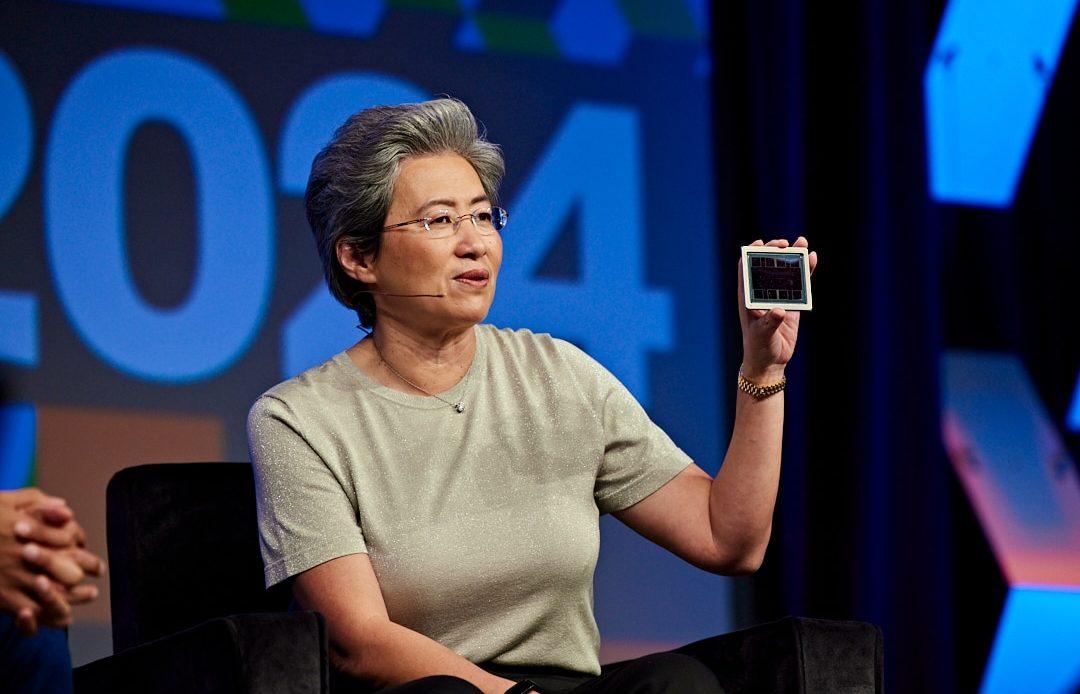
Shares of Advanced Micro Devices rose about 1.3% in early Wednesday trading after the company announced a new supply agreement aimed at supporting its next-generation artificial intelligence chips.
The move came despite weakness across broader US markets, highlighting investor focus on AI-driven growth opportunities within the semiconductor sector.
Broader markets weighed by inflation data
The Dow Jones Industrial Average fell 351 points, or 0.8%, while the S&P 500 declined 0.5%.
The Nasdaq Composite also slipped 0.5%.
The decline followed a stronger-than-expected producer price index (PPI) report, which showed wholesale prices rising 0.7% in February, well above the 0.3% increase forecast by economists.
The data reinforced concerns that inflation remains persistent, even before factoring in rising energy costs tied to the Iran conflict.
Samsung partnership targets HBM4 supply
AMD said it has signed a memorandum of understanding with Samsung Electronics to expand its strategic partnership on memory chip supplies for AI infrastructure.
The agreement focuses on securing next-generation high-bandwidth memory, or HBM4, for AMD’s upcoming Instinct MI455X AI accelerators.
It also includes optimised DDR5 memory for AMD’s sixth-generation EPYC processors.
Samsung will position itself as a key HBM4 supplier for AMD’s next-generation AI GPUs, building on an existing relationship in which it already provides HBM3E memory for AMD’s current accelerators.
The companies also said they would explore a potential foundry partnership, under which Samsung could manufacture next-generation AMD chips.
AI chip race intensifies
The partnership comes as chipmakers race to lock in long-term supply of advanced memory components, which have become critical for AI workloads.
High-bandwidth memory is in particularly tight supply, with demand surging as companies build out large-scale data centres and AI infrastructure.
Samsung currently holds about 22% of the global HBM market, according to Counterpoint, trailing SK Hynix, which leads with a 57% share.
The agreement also comes during the same week as Nvidia GTC, where Nvidia announced its own foundry partnership with Samsung and highlighted the importance of HBM4 technology.
AMD has been aggressively expanding its position in the AI market, including a recent agreement to supply up to $60 billion worth of AI chips to Meta Platforms over five years, alongside a similar deal with OpenAI.
Analysts remain cautious
Despite the positive developments, Wall Street analysts remain measured in their outlook on AMD.
Last month, Goldman Sachs analyst James Schneider raised his price target on AMD to $240 from $210 but maintained a Neutral rating, citing concerns about limited near-term operating leverage as the company continues to invest heavily in research and development.
Similarly, DA Davidson analyst Gil Luria initiated coverage with a Neutral rating and a $220 price target.
Luria argued that AMD may be lagging in building a comprehensive ecosystem, particularly in software and networking capabilities, compared with Nvidia.
The post AMD stock rises over 1% even as markets fall: here’s why appeared first on Invezz